Portrait: Ulrich Zwingli
Portrait · Reformer
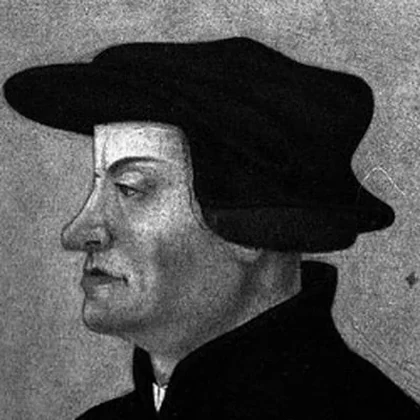
Ulrich Zwingli
1484 – 1531 · Zurich · Scripture alone in worship
- Born1 January 1484, Wildhaus (Switzerland)
- Where he was activeGlarus, Einsiedeln, then Zurich (Grossmünster)
- LegacyPreaching through the Bible book by book, and the Swiss Reformed branch
The son of peasants from the Toggenburg, trained in humanism and an admirer of Erasmus, Zwingli is a priest at Glarus and then at Einsiedeln, where he preaches Scripture rather than pilgrimage legends. Called to the Grossmünster in Zurich in 1519, he breaks with the calendar of prescribed readings: he opens the Gospel of Matthew at the first verse and expounds it to the last, then book after book. That same year the plague carries off a quarter of the city; struck down himself, he survives and draws from it a song of complete trust in God.
From 1522 the Zurich Reformation advances through public disputations: before the city council, Zwingli maintains that Scripture alone has authority. Worship is simplified, the Mass abolished (1525), the Zurich Bible completed by 1531. But Protestant unity breaks at Marburg (1529): for Zwingli the Lord’s Supper is a memorial; for Luther, a real presence — the two men part without reaching agreement. In Zurich itself, his disciples Conrad Grebel and Felix Manz, judging the reform too slow, baptise adults from 1525: Anabaptism is born.
Chaplain to the Zurich troops, Zwingli dies at the Battle of Kappel in 1531, aged forty-seven. His successor Heinrich Bullinger consolidates the work for forty years and corresponds with the whole of Europe. From Zurich comes the Swiss Reformed branch which, joined by Geneva, will form the Reformed family — and, as an unintended consequence, the Anabaptist and Mennonite family.
Why he matters for today’s churches
“Consecutive” preaching, which opens a book of the Bible and works through it verse by verse, Sunday after Sunday, is today the ordinary practice of thousands of evangelical churches: it comes from the Grossmünster. Zwingli is also a reminder that a reform is judged by Scripture — even when it is led by Reformers.
Come to Me, all you who are weary and burdened, and I will give you rest.
(BSB) — Christ’s invitation, at the heart of his preaching at the Grossmünster
Online guide · church families and key points · 2026 edition