Portrait: Jan Hus
Portrait · forerunner
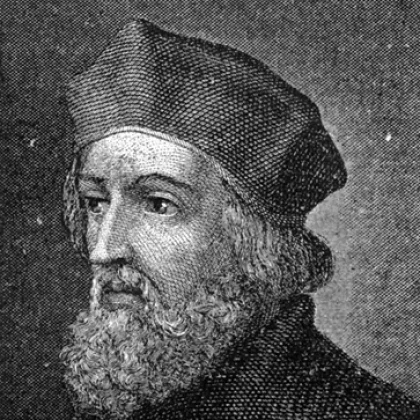
Jan Hus
c. 1372 – 1415 · Prague · the Unity of the Brethren
Later depiction: no contemporary portrait is known. Sources
- Bornc. 1372, Husinec (Bohemia)
- Where he was activePrague, Bethlehem Chapel; died at Constance
- LegacyA people attached to the Bible in Czech, then the Unity of the Brethren
A priest and professor, rector of the University of Prague, Hus preaches from 1402 at the Bethlehem Chapel, in Czech rather than Latin, before large crowds. Nourished by Wycliffe’s writings, he calls the Church to poverty and to faithfulness to Scripture, denounces the sale of indulgences (1412) and affirms that Christ, not the pope, is the head of the Church. Excommunicated, he has to leave Prague.
Summoned to the Council of Constance under the protection of an imperial safe-conduct, he is imprisoned there and ordered to recant, and refuses unless he is convinced from Scripture. He is burned alive on 6 July 1415, singing. His death stirs Bohemia: the Hussite Wars, then, in 1457, the birth of a church of peace and gospel simplicity, the Unity of the Brethren (Unitas Fratrum).
A hundred years later, Luther discovers Hus’s writings and acknowledges: “we are all Hussites without knowing it”. Crushed by the Counter-Reformation after 1620, the Unity of the Brethren survives in secret, and it is its remnant that will be reborn at Herrnhut, on Zinzendorf’s estate, in 1722: the Moravians, who appear later in this guide.
Why he matters for today’s churches
Hus links the forerunners directly to the revivals: without him, no Unity of the Brethren; without the Unity of the Brethren, no Moravians; without the Moravians, no conversion of Wesley and no Methodism. He also shows the price that people long paid for simply asking to be convinced by Scripture.
Then you will know the truth, and the truth will set you free.”
(BSB) — truth (veritas) was his word: “Seek the truth, listen to the truth, learn the truth, love the truth, speak the truth, hold the truth, defend the truth until death”
Online guide · church families and key points · 2026 edition