Portrait: Martin Luther
Portrait · Reformer
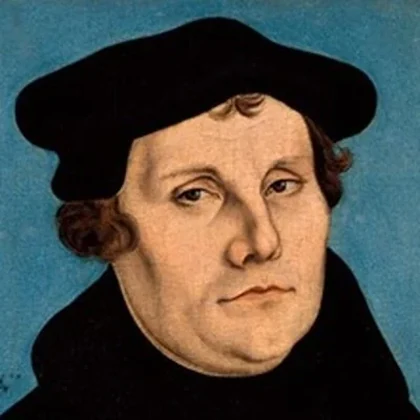
Martin Luther
1483 – 1546 · Wittenberg · faith alone
- Born10 November 1483, Eisleben (Saxony)
- Where he was activeWittenberg; Worms and the Wartburg
- LegacyThe German Bible, salvation by faith alone, the Lutheran churches
The son of a miner, Luther becomes an Augustinian monk and anxiously searches for a way to be righteous before a holy God: fasts, vigils, confessions — nothing calms his conscience. As professor of Holy Scripture at Wittenberg, he discovers while studying the Epistle to the Romans that the righteousness of God is not the righteousness that condemns, but the righteousness that God gives: salvation is received by faith, as a gift. On 31 October 1517 his Ninety-five Theses against the trade in indulgences are spread by the printing press across Europe within a few weeks.
Excommunicated and summoned before Emperor Charles V at the Diet of Worms (1521), he refuses to recant unless he is convinced “by the testimony of the Scriptures or by clear reason”. Placed under the ban of the Empire and hidden at Wartburg Castle, he translates the New Testament into German in eleven weeks (1522), then the whole Bible (1534): from now on the people read Scripture in their own language. Back in Wittenberg, he reorganises worship, writes hymns — “A Mighty Fortress Is Our God” — and two catechisms for families.
His marriage to Katharina von Bora, a former nun (1525), inaugurates the Protestant parsonage: an open table, six children, students given lodging. The Augsburg Confession (1530), drafted by his friend Melanchthon, defines the Lutheran faith. A man of strong convictions who could be harsh in controversy, he dies in 1546 in Eisleben, his birthplace. From him come the Lutheran churches of Germany, Scandinavia and Alsace.
Why he matters for today’s churches
Every time an evangelical church proclaims that salvation is received by faith, not earned by works, it repeats the discovery of Wittenberg. The Bible in the language of the people, singing by the whole congregation, the family catechism: three of Luther’s practices that have become so natural that we forget they were a revolution.
“The righteous will live by faith.”
(BSB) — the verse of his deliverance, discovered in his study at Wittenberg
Online guide · church families and key points · 2026 edition