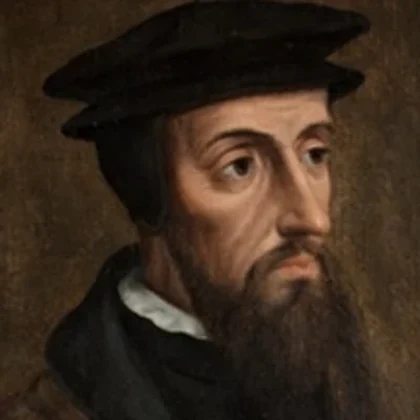
John Calvin

Portraits

John Calvin: his life, the Institutes, Geneva, the training of pastors and the heritage of the Reformed churches.

Portrait · Reformer

Portrait of John Calvin (French school, 16th century)

John Calvin

1509 – 1564 · Noyon, then Geneva · to God alone the glory

  • Born10 July 1509, Noyon (Picardy)
  • Where he was activeGeneva, after Paris, Basel and Strasbourg
  • LegacyThe Institutes, the Geneva Academy, the Reformed and Huguenot churches

A Frenchman from Noyon, trained in law and letters, Calvin is won over to the Reformation around 1533 — “God … subdued and brought my mind to a teachable frame”, is all he will write of it (Preface to the Commentary on the Book of Psalms, translated by James Anderson). After the Affair of the Placards (1534), he flees France. In 1536, at twenty-six, he publishes in Basel the Institutes of the Christian Religion, the first comprehensive exposition of the Reformed faith, which he translates into French himself in 1541 — making his language a language of theology.

Kept in Geneva by Guillaume Farel, expelled in 1538, married in Strasbourg to Idelette de Bure, he returns in 1541 and organises the church to last: pastors, teachers, elders and deacons, and worship centred on preaching and the singing of the Psalms in French. His ministry also has its shadows: the trial of Michael Servetus, burned in Geneva in 1553 with the approval of the authorities and of Calvin, is a reminder of this. In 1559 he founds the Geneva Academy, which trains pastors for the whole of Europe.

Dozens of them return secretly to France: from 1555 the first formally organised Reformed congregations appear — Paris, Meaux, Poitiers — and in 1559 the first national synod adopts a confession of faith. Worn out, Calvin dies in 1564, asking for an unmarked grave. From him come the Reformed and Presbyterian churches of the whole world, and the Huguenots whose history this guide follows.

Why he matters for today’s churches

Calvin gave the churches that came out of the Reformation what allowed them to stand without the support of a prince: a confession of faith, shared ministries, trained pastors. Today’s Evangelical Reformed churches — and, more broadly, any church that elects a council and trains its pastors — are heirs of Geneva.

Not to us, O LORD, not to us, but to Your name be the glory, because of Your loving devotion, because of Your faithfulness.

(BSB) — what the Reformation summed up in three words: Soli Deo gloria, to God alone the glory
To continue

Online guide · church families and key points · 2026 edition

GOING FURTHER

Further reading

Three key points to understand John Calvin better.
Open the topics that interest you, at your own pace.

His role in GenevaA pastor, institutions and a city in reformation

When Calvin arrives in Geneva in 1536, the city has already chosen the Reformation. Guillaume Farel keeps him there to help organise it. Expelled in 1538, Calvin returns in 1541: his influence grows through conflicts and negotiations with the city authorities.

The Ecclesiastical Ordinances distribute responsibilities among pastors, teachers, elders and deacons. Preaching, teaching, discipline and care for the poor thus give structure to church life. The Academy founded in 1559 helps to train pastors whose work reaches far beyond Geneva.

Distinguishing responsibilities

Calvin exercises considerable religious authority; the city councils keep civil power. This distinction does not remove the religious constraints of the time: Calvin approves the condemnation of Michael Servetus, executed in 1553 by the Genevan authorities.

Sources: Musée protestant, Jean Calvin (1509–1564) (in French); Jean Calvin, document for teachers (PDF, in French).

Understanding his main ideasGrace, Scripture and the Christian life

In the Institutes of the Christian Religion, Calvin sets out an understanding of faith centred on God and his grace. The salvation received in Jesus Christ is not earned by works: justification is received by faith. For him, Scripture is the decisive reference for Christian teaching.

He also seeks to organise a community instructed in this faith: preaching, catechism, the singing of the Psalms and the training of ministers accompany his theological work.

Placing predestination in context

Calvin teaches double predestination, concerning salvation and reprobation, to affirm that salvation depends on God. This doctrine has given rise to debate: it is one theological interpretation within Christian history, and does not on its own sum up his whole work.

Sources: Musée protestant, La doctrine de Jean Calvin (in French); Jean Calvin (1509–1564) (in French).

Common ground and differences with LutherOne Reformation, several developments

Luther and Calvin share the affirmation of salvation by grace, received by faith, and the authority of Scripture. Calvin belongs to the next generation: he takes up convictions of the Reformation and develops them in a different context.

The Lord’s Supper reveals an important difference. Luther affirms the real presence of the body and blood of Christ with the bread and wine. Calvin insists on a real participation in Christ through the work of the Holy Spirit: his understanding therefore cannot be reduced to the symbolic remembrance of someone absent.

Connecting the portraits to the families

These differences shed light on the history of the Lutheran churches and the Reformed churches. The portrait of Martin Luther lets you take up the comparison again from his own questions.

Sources: Musée protestant, La doctrine de Jean Calvin (in French); Jean Calvin, section “La Cène” (PDF, in French).

You can close each topic and continue the journey.

Sources and key references

Bibliography of the journey

  • Sébastien Fath, Une autre manière d’être chrétien en France. Socio-histoire de l’implantation baptiste (1810-1950) [Another way of being Christian in France: a social history of the establishment of Baptist churches in France, 1810–1950], Labor et Fides.
  • Sébastien Fath and Jean-Paul Willaime (eds.), La nouvelle France protestante. Essor et recomposition au XXIe siècle [The new Protestant France: growth and reconfiguration in the 21st century], Labor et Fides.
  • André Encrevé (ed.), Les protestants [The Protestants] (Dictionnaire du monde religieux dans la France contemporaine), Beauchesne.
  • Patrick Cabanel, Histoire des protestants en France, XVIe-XXIe siècle [A history of Protestants in France, 16th–21st century], Fayard.
  • Jean Baubérot, Histoire du protestantisme [A history of Protestantism], PUF, “Que sais-je ?”.
  • Musée virtuel du protestantisme (Virtual Museum of Protestantism) — thematic and biographical entries (in French).

See all the sources of the journey

Further reading